
Search
Called to Teach, to Govern, to Sanctify
-
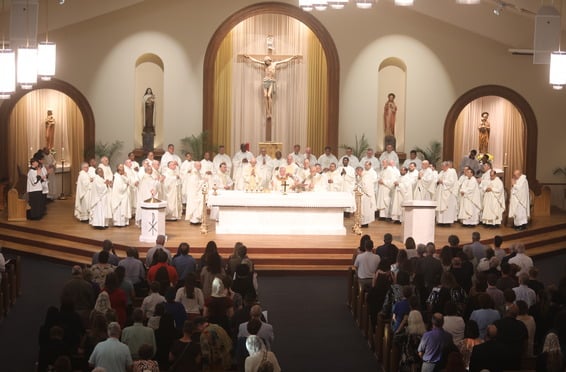 December 24, 2025Many Catholics encounter their bishop only on special occasions—such as confirmations or ordinations, or when attending Mass on feast days at the cathedral, or when a parish church is dedicated. They may see a video from him on social media a few times a year or hear an announcement from him at their parish. But what exactly is the role of a bishop in the Catholic Church? Who is a bishop meant to be, and what is his charge?
Who is a bishop?
Through the sacrament of Holy Orders, men are ordained to carry out the “mission entrusted by Christ to his apostles … thus, it is the sacrament of apostolic ministry” (Catechism of the Catholic Church, 1536). Holy Orders “includes three degrees: episcopate (bishops), presbyterate (priests), and diaconate (deacons)” (CCC 1536). In the ordination of a bishop, the “fullness of the sacrament of Holy Orders is confirmed”—the bishop is “typos tou Patros: he is like the living image of the Father” (CCC 1557, 1549).
It is also through the bishops that an unbroken and direct line of succession to the apostles is maintained in the Catholic Church, with the “gift of the Spirit” needed to fulfill this role being “transmitted down to our day through episcopal consecration.” (CCC 1556, quoting Lumen Gentium, Dogmatic Constitution on the Church 21). The bishops succeed the apostles as “shepherds of the Church” (LG 20) and each bishop is the pastor “of the portion of the flock that is entrusted to his care” (CCC 1560). When the bishop celebrates Mass, it has a “special significance” as he “represents Christ, the Good Shepherd and Head of his Church, presiding” (CCC 1561).
But though he holds the “chief place” among church offices (CCC 1555), in the words of Pope Leo XIV, quoting Pope Francis, “the only authority [a bishop] has is service, and it is a humble service” (Pope Leo XIV to new bishops and to bishops of mission countries, September 11, 2025). A bishop is a “witness to hope by his example of life firmly grounded in God and completely devoted to the service of the Church” (Pope Leo XIV at the Jubilee of Bishops, June 25, 2025).
A bishop’s duties
Consecration as a bishop confers three offices—of teaching, governing, and sanctifying—taking “the place of Christ himself, teacher, shepherd, and priest” and acting as Christ’s representatives (CCC 1558, quoting LG 21). These offices are “intimately interconnected” and “following the example of the Good Shepherd, the entire ministry of the bishop is focused on serving God and the flock” (Apostolorum Successores, Directory for the Pastoral Ministry of Bishops, 1).
Called to teach
Christ “entrusted to his Apostles the mission of ‘making disciples,’” and that mission falls “particularly so on Bishops,” who are the successors to the apostles (Pastores Gregis, Pope St. John Paul II, 26). In practice, a bishop teaches directly through sermons, addresses, letters to the faithful in his diocese, writings such as newspaper columns, pamphlets, or books, and—in the modern era—radio and television shows, podcasts, and even YouTube channels. Bishops oversee the dissemination of Catholic truths in their diocese through official channels and continually seek new ways to bring the faith to people. A recent example of this was the launch of the Corpus Christi Catholic Network app, which offers on-demand local Catholic content and live Sunday Mass broadcast (in English and Spanish). The app arose from Bishop Michael Mulvey’s dedication to finding new ways to reach people through social media.
Called to govern
Bishops are also charged with overseeing the needs of their diocese, serving as stewards of diocesan finances and property, ensuring that church laws are followed, and training, providing, and managing priests and others in ministry. In the Diocese of Corpus Christi, Bishop Mulvey oversees six deaneries—Alice, Beeville, Corpus Christi Northside, Corpus Christi Southside, Kingsville, and Refugio—each containing numerous parishes, missions, and Catholic schools. There are many diocesan offices, ministries, apostolates, programs, and initiatives that the bishop must ensure carry out their duties in keeping with the Catholic faith and good stewardship. In this task, a bishop relies on “the grace of strength … to guide and defend his Church with strength and prudence as a father and pastor” (CCC 1586).
Called to sanctify
A bishop, who is the “Vicar of the ‘great shepherd of the sheep’” (AS 1) and must “not fear ... to give his life for his sheep” (CCC 1586], is also responsible for the spiritual well-being of his flock. He thus has a special charge to see that the sacraments are being administered in his diocese. Only a bishop may ordain priests and (outside of extraordinary circumstances) administer the sacrament of confirmation (CCC 1576, 1313, 1314).
“In exercising their office of sanctifying, bishops should be mindful that they have been taken from among men and appointed their representatives before God in order to offer gifts and sacrifices for sins,” and so must be “mindful of their obligation to give an example of holiness in charity, humility, and simplicity of life.” (Christus Dominus, Decree Concerning the Pastoral Office of Bishops, 15).
A symbol of unity
The bishop is the “visible principle of unity in the particular Church entrusted to him,” and it is his “duty to build communion among its members and with the universal Church” (Meditation of Pope Leo XIV). Thus, in union with his flock—and with their prayers—he goes forth as Christ’s vicar to carry out Christ’s promise to be with His Church “unto the end of the age” (Mt 28:20).