
Coat Of Arms
-
-
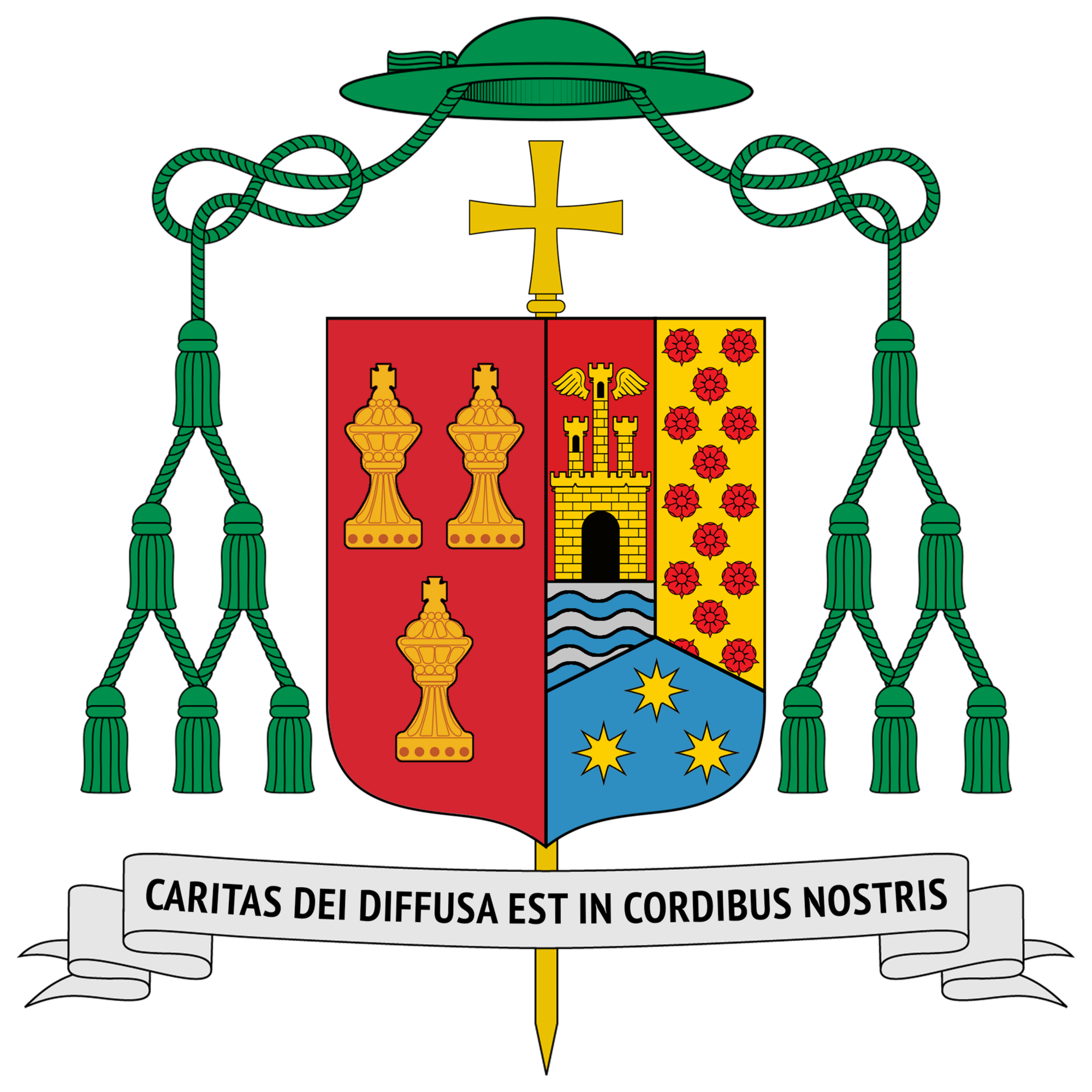
Motto
Caritas Dei diffusa est
in cordibus nostris
The love of God has been poured
into our hearts (Romans 5:5)THE EPISCOPAL HERALDIC ACHIEVEMENT, commonly called the bishop’s coat of arms, is composed of three parts: the scutcheon or shield, which is the distinctive central and most important part of the design; a motto displayed on a scroll; and the external ornamentation.
The practice of design, display, study, and transmission of armorial bearings is called heraldry. While the use of various devices and symbols to identify individuals or groups dates to antiquity, the use of standardized devices that are hereditary in nature developed during the High Middle Ages. These design elements and their names come from this period.
A blazon is a formal description of the heraldic achievement from which one familiar with the terms could reconstruct the design.
The design is described, or blazoned, as if the description is being given by the bearer from behind, with the shield being worn on the left arm. As the heraldic device is viewed from the front, the viewer must remember that the heraldic terms dexter, meaning right, and sinister, meaning left, are described for the bearer; for the viewer, the directions are reversed.
By tradition in the Roman Catholic Church, the heraldic achievement, the arms of bishops, contains a shield with its charges or symbols of family, geographic, religious, or historical importance; a golden processional cross with one traversal bar indicating the rank of bishop, impaled vertically behind the shield; a green galero with twelve tassels, six on each side, arranged one, two, and three from the top; and a motto written in black, displayed on a scroll below everything.
A bishop of a diocese exercises ordinary jurisdiction connected with their office. In this case, the personal arms of the Ordinary are marshalled with the arms of their diocese.
BLAZON
The arms of the Diocese of Corpus Christi are a red field with three gold ciboria. A ciborium is a liturgical vessel that holds the consecrated species of the Blessed Sacrament, the real and true presence of Jesus Christ. These consecrated hosts are the Body of Christ, Corpus Christi.
The diocesan arms are marshalled by impalement per pale, dividing the shield in half vertically, and displayed dexter, the bearer’s right and the viewer’s left.
Bishop Avilés’ personal arms are composed of a scutcheon tierced per pall reversed, divided into three sections in an upside-down Y shape.
The dexter chief is a field of red with a triple-towered castle, the center tower higher and winged, all in gold, opened and with windows in black, placed on a field of silver with blue waves. This is the design of the Avilés family crest traced to the Kingdom of Castile in medieval Spain. For Bishop Avilés, it represents the importance of essential virtues and the unity inherent in family life.
The sinister chief is a field of gold with a pattern of red roses. The roses honor the Blessed Virgin Mary under her title of Our Lady of Guadalupe and recall the Mexican heritage of Bishop Avilés, as well as the miracle of the roses used to impress her image on the tilma.
The middle base is a field of blue with three eight-pointed gold stars. This design is taken from the Neri family crest and is used by the Congregation of the Oratory of Saint Philip Neri, of which Bishop Avilés has been a member since the beginning of his vocation.
Bishop Avilés’ arms are impaled per pale sinister, on the bearer’s left and the viewer’s right of the divided shield.
Bishop Avilés chose Caritas Dei diffusa est in cordibus nostris as his motto. Translated as “The love of God has been poured out into our hearts,” it recalls Saint Paul’s Letter to the Romans, chapter five, verse five, and is used as the Introit for the Mass of the Feast of Saint Philip Neri in remembrance of his mystical experience while praying in the Catacombs of Saint Sebastian in Rome.
The heraldic achievement is completed by the external ornaments, the golden processional cross with one traversal bar and the green galero with twelve tassels arranged in three rows, which together signify the rank of bishop.
-