
Preparing the ground for a cultural change
-
 December 24, 2025
What can be done to encourage vocations—whether to the priesthood, religious life, or sacramental marriage? Creating fertile soil is one way to put it. And one woman, who never intended to become a mentor in Vocation Ministry, inspires Catholics across the country to promote vocations—and it works!
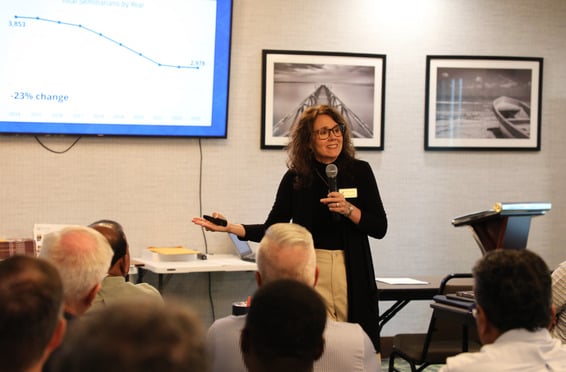
Rhonda Gruenewald would never have imagined that she would someday lead workshops on fostering vocations. “I grew up in a family without faith,” she shared during the workshop for the priests of our diocese in October. A few times, she attended the Methodist Church. During college, she was searching for something more, and at 25, she was baptized.
Then she met her husband, David, a Catholic. Long story short, she converted to Catholicism, got married in the Church and raised three children in the faith.
Getting involved
In 2011, Fr. Victor Perez, a priest from the Diocese of Galveston-Houston, wanted to revive the parish vocation committee and asked her if she could help— it was “one of the most important ministries in the parish.” Since the priest asked her directly, she agreed, and the group became vibrant and thriving. When she was asked to share her secrets, she took advantage of the pandemic hiatus and wrote a book. “I thought that my contribution was done,” says Rhonda. However, she was asked to speak at a Vocation Directors’ Conference, and afterward, more dioceses asked, “Can you come and train our priests?”
The workshop in Port Aransas was her 280th; more than 78 dioceses had sought her help. The changes in some dioceses are impressive: in 2015, she visited the Diocese of Grand Island in Nebraska, which has 48,000 Catholics in a fairly large territory. At that time, they had only one seminarian. Just four years later, they had nine young men in formation. For example, the Archdiocese of Hartford, Connecticut: over ten years, they averaged about one new seminarian each year – not a lot for an archdiocese. In the weeks after the workshop, the vocation director received 80 phone calls, and five young men entered seminary the next year. Additionally, 15 permanent deacons began their formation, and 11 young women are interested in religious life.
A culture of vocations
What is the secret? Rhonda Gruenewald says we need to foster a culture of vocations: “We stopped talking about vocations decades ago – it has to become normal again that every young man thinks about the priesthood, and young women ask themselves if they are called to religious life or marriage.” Not long ago, every family had an aunt who was a sister or an uncle who was a priest, and it was common for children to consider God’s will as they grew up. What can be done to bring this back? Prayer is one small step that everyone and every parish can take immediately, but it doesn’t end there. She refers to Mark 4:8, about the seeds sown on fertile soil: “We have to prepare the ground.”
The parish is the best starting point. According to a CARA survey, most priests felt the calling first between ages 6 and 13, followed by 21% between 14 and 17. Only 19% felt called during college, and 20% at age 27 or older. These age ranges also roughly reflect the responses of young women.
“This means that most people discover their vocation before age 18, when we can reach them through the parish.” On her website, she provides free resources—homily ideas for priests related to the Sunday Gospel, bulletin blurbs, and talking points for discussing vocations. However, change occurs only if vocations become a part of everyday life: “During marriage prep or baptismal classes, encourage parents to consider that their children are called to something great. Other effective tools include traveling chalices or crucifixes, in which a family commits to praying daily for vocations for one week. An active youth ministry also promotes vocations, as does perpetual or frequent adoration hours.
Discouraging numbers
The outlook for the Church and our diocese remains concerning. Currently, the Diocese of Corpus Christi has three seminarians, following the ordination of three priests in June. At present, our diocese has 118 active priests serving in 69 parishes. Nearly 56% are over 60 years old. The average ordination rate is 1.1 priests per year. If trends continue, there will be only 54 active priests in 2035, serving a Catholic population that grows by about 1% annually. In 15 years, just 33 active priests will remain, each serving approximately 8,883 parishioners. This mirrors the nationwide trend in the U.S. Church: active priest numbers have declined by 12% over the past nine years. Priests in religious orders are down by 15%, and religious sisters have decreased by 29%.
These numbers are sobering, but Rhonda would not highlight that. “Depression is not a good selling tactic; we should not manage the decline,” she explains. A vocation is answering a call from God, not just a duty. The focus should be on discovering God’s personal calling: “If we stop dreaming big, we put the Holy Spirit in a box.”
Besides that, more things can be done or are already in the process of changing. Many young men considering the vocation to the priesthood are afraid of loneliness. The seminary now focuses its formation on learning to live in communion and building friendships, rather than heavy philosophy and theology. However, Rhonda believes the most essential tool is to make considering a vocation normal again and to talk about the priesthood and religious life as ways to live a holy, fulfilled life. “Vocations should be a year-long conversation, not only during Vocation Awareness Week.” She asked the priests to think about what brings them joy in the priesthood – and many beautiful answers came up. “Pope Leo XIV reminds us that being a priest is beautiful and that receiving a call from the Lord is a call to experience His joy,” says Rhonda.
Already, a change is on the horizon: Gen Z is returning to the Church – according to surveys, those born after 2000 are more religious than previous generations. They hunger for authenticity and radical answers - orders that wear a habit and strict rules have more vocations. There is hope: “We just have to start with prayer – praying for vocations from our own parish, and our own family.”
Free resources for parishes and families are available at Vocationministry.com.