
Search
The Holy Family – a Timeless Model of Virtue
-
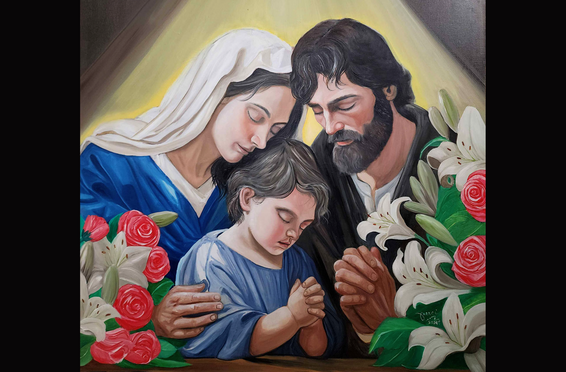 February 4, 2026Much like families today, the Holy Family had a simple rhythm to their lives, alternating work and prayer. They also had a deep respect for the existing civil law of their time and a deep devotion to God. By many accounts, the daily family life of the Holy Family was very ordinary. This ordinariness sanctifies the everyday: the Holy Family is the “prototype and example for all Christian families,” the original “Church in miniature – Ecclesia domestica” (Pope John Paul II, Redemptoris Custos, 7). In this ordinary fashion, the family worked and prayed together, much like families are called to do today. Note their simplicity, their obedience, and the silence that marked their home lives.
Joseph as Head of the Household. St. Joseph, a silent leader, was a man of action, a true leader and model for every family man today. “Joseph ... would have led the prayers at home both every day – in the morning, in the evening, at meals – and on the principal religious feasts. In the rhythm of the days he spent at Nazareth, in the simple home and in Joseph’s workshop, Jesus learned to alternate prayer and work” (Pope Benedict XVI, General Audience, December 28, 2011). Working together daily, the two would have managed the ups and downs of daily labor. For these reasons, the Catholic Church designates him as the principal patron saint of workers.
St. Joseph, Head of the Holy Family, Pray for us.
Mary as home caretaker. The life of Mary was similarly marked by silent, steady work. Mary managed household duties – cooking, cleaning, and caring for the home – exemplifying the mother's sacrificial role (Pope Francis, General Audience, December 17, 2014). Because of Mary’s yes at the Annunciation (Luke 1:46-55), we are confident that all the family trials and turmoil were met with similar acceptance. Not only that, but she would likely have quietly dealt with the common struggle of raising a family. Her style was silent and contemplative. The Gospels make this clear: after the shepherds’ visit, “Mary treasured all these things and pondered them in her heart” (Lk 2:19); following Jesus’ Temple discourse at age 12, “his mother treasured all these things in her heart” (Lk 2:51).
Our Lady of Silence, Pray for us.
Jesus – Obedient to His parents and God. The Catechism of the Catholic Church teaches that, for about 30 years, Jesus lived an obedient life. As such, he shared the “condition of the vast majority of human beings: a daily life spent without evident greatness, a life of manual labor as a Jew obedient to God’s law” (CCC 531). He learned at Joseph’s “school” to do the Father’s will—his “daily food” (see Jn 4:34). When he found occasion to wonder, he was found in the sacred worship space and immediately returned to his parents. Pope Francis notes this episode in Jesus’ youth: after being “lost and found in the Temple,” he returned obedient, but the event highlights his bond with the Father’s dwelling. Following this, from age 12 until the beginning of his public ministry, his life remained silent and ordinary. This highlights Jesus’ deliberate choice of an ordinary, humble existence marked by family obedience, manual labor, prayer, and growth in wisdom, modeling the sanctity of everyday Christian life (CCC 534).
Jesus, Most Obedient, Pray for us.
Modeling the Holy Family – The Domestic Church
How can we faithfully model the example of the Holy Family today in a society riddled with division, violence, war, and political polarity? The answer is to build up the “domestic Church” in our own homes. For the Christian home is the place where children receive the first proclamation of the faith. For this reason, the family home is rightly called “the domestic church,” a community of grace and prayer, a school of human virtues and Christian charity (CCC 1666). This article will simply offer a starting point and a few simple steps for families to build upon or continue the work towards a domestic church.
Perhaps the first step in modeling the Holy Family is to reflect on the virtue of silence that underlies their lives. As such, the starting point for creating a domestic church is to foster a home environment of silence. Pope Paul VI, when referencing the Holy Family, spoke of it as “a school of the Holy Family,” which, in the first place, “teaches us silence. Oh! If only esteem for silence, a wonderful and indispensable spiritual atmosphere, could be reborn within us!” (Discourse in Nazareth, January 5, 1964). While the simplest in theory, it is probably the most difficult in practice. As parents, we can easily work on turning off the TV and radio in the home, perhaps for 10–15 minutes to start. The fruits of a silent home will create an atmosphere of peace, allowing the Holy Spirit to foster continued growth through prayer, catechesis, and acts of consecration, as noted below.
Consecrate Your Family to the Holy Family
How can we, as a family, consecrate (or dedicate) ourselves to the Holy Family this February, either entirely or through small steps? Here are a few suggestions:
• Place an image or statue of the Holy Family in your home or workplace
• Pray together
• Pray the Rosary together or have it played to you, for example: dailyrosary.net
• Go to Holy Mass as a Family
• Go to Confession as a Family
• Ask a Priest to bless your home
Prayer to the Holy Family
From Amoris Laetitia (Pope Francis)
Jesus, Mary and Joseph,
in you we contemplate the splendor of true love; to you, we turn with trust.
Holy Family of Nazareth,
grant that our families too may be places of communion and prayer, authentic schools of the Gospel and small domestic churches.
Holy Family of Nazareth,
may families never again experience violence, rejection and division;
may all who have been hurt or scandalized find ready comfort and healing.
Holy Family of Nazareth,
make us once more mindful of the sacredness and inviolability of the family,
and its beauty in God’s plan.
Jesus, Mary and Joseph,
graciously hear our prayer.
Amen.
Painting by Merci McCoy, mercedesoriginals.com