
Search
A Model of Silence, Justice, and Purity
-
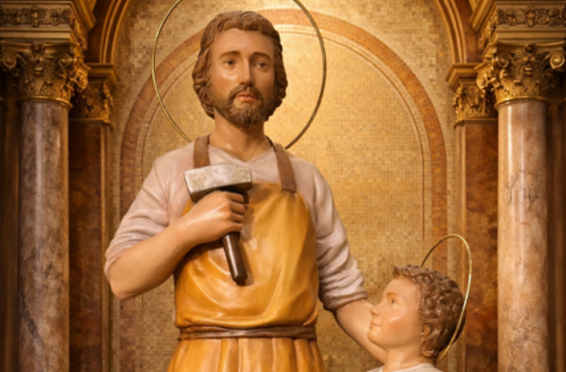 March 18, 2026The month of March is traditionally dedicated to St. Joseph., foster father of Jesus and head of the Holy Family of Nazareth. His solemnity falls on March 19, making it a focal point for liturgical and popular devotion dedicated to him as the Spouse of the Blessed Virgin Mary, foster father of Jesus, and Patron of the Universal Church.
Key Highlights- St. Joseph is the patron of the Universal Church, workers, fathers, Christian families, the dying, and a happy death.
- His Feast Day is on March 19.
- Devotions: Many pray the St. Joseph Novena (March 10–18) and attend Mass on his feast day.
- Symbolism: He is honored as a model of virtue—specifically silence, justice, and purity—and a protector against evil.
The Power of St. Joseph
St. Joseph’s spiritual power as intercessor stems from his singular proximity to Jesus and Mary as head of the Holy Family, his heroic virtues that terrify demons, and his divinely entrusted patronage over the Church. Directory on Popular Piety and Liturgy (9 April 2002). The name Joseph in Hebrew means “May God increase” or “May God add/give growth”. It is easy to see that God increased Joseph’s life by blessing him with the responsibility and privilege of raising Jesus from infancy to manhood. So, in his very name was his life’s vocation- to “add and give growth” by daily nurturing, supporting, feeding, and guiding Jesus, who is God. This honorable task required a certain power that, although human in every way, he embodied spiritual strength only possible through his faith in God.
Patron Saint of the Interior Life and Head of the Holy Family
Born in Bethlehem, which means “house of bread,” St. Joseph’s strength comes from his silence and obedience. He was known to have mastered his interior life. Although silent and obedient, he always cooperated with God’s plan and was never known to doubt or question his mission as protector of the Holy Family, but rather acted quickly and decisively. He did so always. For example, Joseph, as Mary’s principal guardian, obeyed divine commands as he fled to Egypt with “the child and his mother” (Mt 2:14), returning (Mt 2:21), and settling in Nazareth.
Although there are no recorded words in Scripture, as head of the Holy Family, Joseph “would have led the prayers at home both every day, in the morning, in the evening, at meals—and on the principal religious feasts. In the rhythm of the days he spent at Nazareth, in the simple home and in Joseph’s workshop, Jesus learned to alternate prayer and work” (Pope Benedict XVI, General Audience, December 18, 2011). Working together daily, the two (Jesus and St. Joseph) would have managed the ups and downs of daily labor just as we do today.
The Intercession of St. Joseph
Seek St. Joseph’s intercession any time, but especially before and throughout the workday. This can be done through approved prayers, litanies, and liturgical rites—especially in March, on Wednesdays, and his feasts—to implore his aid as faithful guardian of Christ and the Church (Directory on Popular Piety and Liturgy: Principles and Guidelines, 221-223). The Litany of St. Joseph can be found here https://www.usccb.org/prayers/litany-saint-joseph.A prayer to St. Joseph the Worker below is recommended daily for anyone engaged in meaningful work:
Prayer to St. Joseph, the WorkerO Glorious, St. Joseph, model of all those who are devoted to labor, obtain for me the grace to work conscientiously, putting the call of duty above my natural inclinations, to work with gratitude and joy, in a spirit of penance for the remission of my sins, considering it an honor to employ and develop by means of labor the gifts received from God, to work with order, peace, moderation and patience, without ever shrinking from weariness and difficulties, to work above all with purity of intention and detachment from self, having always death before my eyes and the account that I must render of time lost, of talents wasted, of good omitted, of vain complacency in success, so fatal to the work of God. All for Jesus, all through Mary, after your example, O Patriarch, St. Joseph. Such shall be my watchword in life and in death. Amen. —Pope St. Pius X