
“Like living stones, let yourself be built into a spiritual house” (1 Peter 2:5)
-
 January 6, 2026
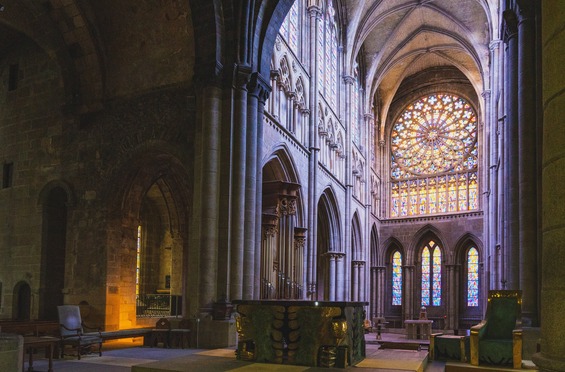
The Vatican II document on the Church, Lumen Gentium, drawing from the Old and New Testaments, offers a poetic variety of images to describe the Church: The People of God, the Mystical Body of Christ, the Bride of Christ, a sheepfold, a cultivated field, and more. Among these images, the document also presents the Church as a building — a spiritual house made of living stones. This image helps us understand the significance of the Cathedral, the mother church in every diocese, and particularly in the Diocese of Corpus Christi.
Lumen Gentium 6 beautifully articulates this vision:
“The Church is called the building of God (1 Cor 3:9). The Lord compared Himself to the stone which the builders rejected, but which was made into the cornerstone (Mt 21:42; cf. Acts 4:11; 1 Pet 2:7; Ps 117:22). On this foundation the Church is built by the apostles (cf. 1 Cor 3:11) and from it the Church receives solidity and unity. This edifice has many names to describe it: the house of God in which His family dwells — the household of God in the Spirit (Eph 2:19, 22); the dwelling place of God among men (Rev 21:3); and, especially, the holy temple. This temple, symbolized in places of worship built out of stone, is praised by the Fathers and, not without reason, is compared in the liturgy to the Holy City, the New Jerusalem. As living stones, we here on earth are built into it (1 Pet 2:5).”
To grasp the depth of this teaching, we must remember that the Church is both divine and human, visible and invisible: holy and endowed with spiritual gifts, yet also given a visible, organized structure. The unity and solidity of this structure rely on Christ, the cornerstone, and the harmony and fidelity of each “living stone,” the faithful. The beauty of this image lies in how it links the mystical communion of believers in Christ with the physical structures where that communion is made visible and celebrated.
This spiritual reality manifests in concrete, visible forms through Church buildings — especially the Cathedral, which represents the unity of the local Church.
The Cathedral is the bishop’s church, holding the cathedra (chair) that symbolizes his teaching authority and pastoral leadership over the flock entrusted to him by the Good Shepherd. Usually located in the heart of the diocese, the Cathedral serves as a visible sign of unity among the parishes and the faithful. It is the place where the bishop brings together the diocesan family, expressing the full richness of the Church’s unity.
Theologically, the Cathedral represents the local Church gathered around its shepherd, just as the universal Church congregates around the successor of Peter. Its architecture and liturgy clearly demonstrate what Lumen Gentium describes spiritually: the Church as a living temple. The Cathedral hosts important diocesan celebrations — such as the Chrism Mass, Confirmations, and ordinations to the priesthood and diaconate — gatherings that reaffirm communion and mission for all the People of God.
This profound reality is beautifully reflected in our own Cathedral of Corpus Christi, dedicated to the Body of Christ. Its very name highlights its Eucharistic identity, reminding us that the Eucharist is the heart of the Church’s life and unity. “Corpus Christi” captures the mystery of the Church both as the Eucharistic Body we receive and as the Mystical Body we are.
The Cathedral’s architecture, artwork, and liturgical life reveal the communion of the Church: Christ as the cornerstone, the bishop as the visible head, and the faithful as the living stones united in worship. Every Mass celebrated there — especially with the bishop presiding — renews the unity of the diocese in Christ.
Furthermore, Lumen Gentium’s depiction of the Church as a building reminds us that it is not yet complete. The Church remains a structure still under construction until it reaches perfection with Christ in glory. The Cathedral, then, is not just a monument of stone — no matter how magnificent its beauty — but a living sign of a people being built up in faith, hope, and charity.
Particularly here in Corpus Christi, the Cathedral reminds us of who we are called to be: a Eucharistic people, made of living stones, being built into a spiritual house, growing together in unity, “with Christ Jesus Himself as the capstone” (Eph. 2:20–22). As we worship within its walls, we are shaped by grace into a dwelling place of God — and we are sent out as builders of His Kingdom, continuing the work of strengthening and expanding the Body of Christ in our world.